> ## Documentation Index
> Fetch the complete documentation index at: https://nixtlaverse.nixtla.io/llms.txt
> Use this file to discover all available pages before exploring further.
> Autoformer: Transformer with auto-correlation mechanism and progressive decomposition for reliable long-horizon time series forecasting with trend-seasonality.
# Autoformer
The Autoformer model tackles the challenge of finding reliable
dependencies on intricate temporal patterns of long-horizon forecasting.
The architecture has the following distinctive features: - In-built
progressive decomposition in trend and seasonal compontents based on a
moving average filter. - Auto-Correlation mechanism that discovers the
period-based dependencies by calculating the autocorrelation and
aggregating similar sub-series based on the periodicity. - Classic
encoder-decoder proposed by Vaswani et al. (2017) with a multi-head
attention mechanism.
The Autoformer model utilizes a three-component approach to define its
embedding: - It employs encoded autoregressive features obtained from a
convolution network. - Absolute positional embeddings obtained from
calendar features are utilized.
**References**
* [Wu, Haixu, Jiehui Xu, Jianmin Wang, and Mingsheng
Long. “Autoformer: Decomposition transformers with auto-correlation for
long-term series
forecasting”](https://proceedings.neurips.cc/paper/2021/hash/bcc0d400288793e8bdcd7c19a8ac0c2b-Abstract.html)
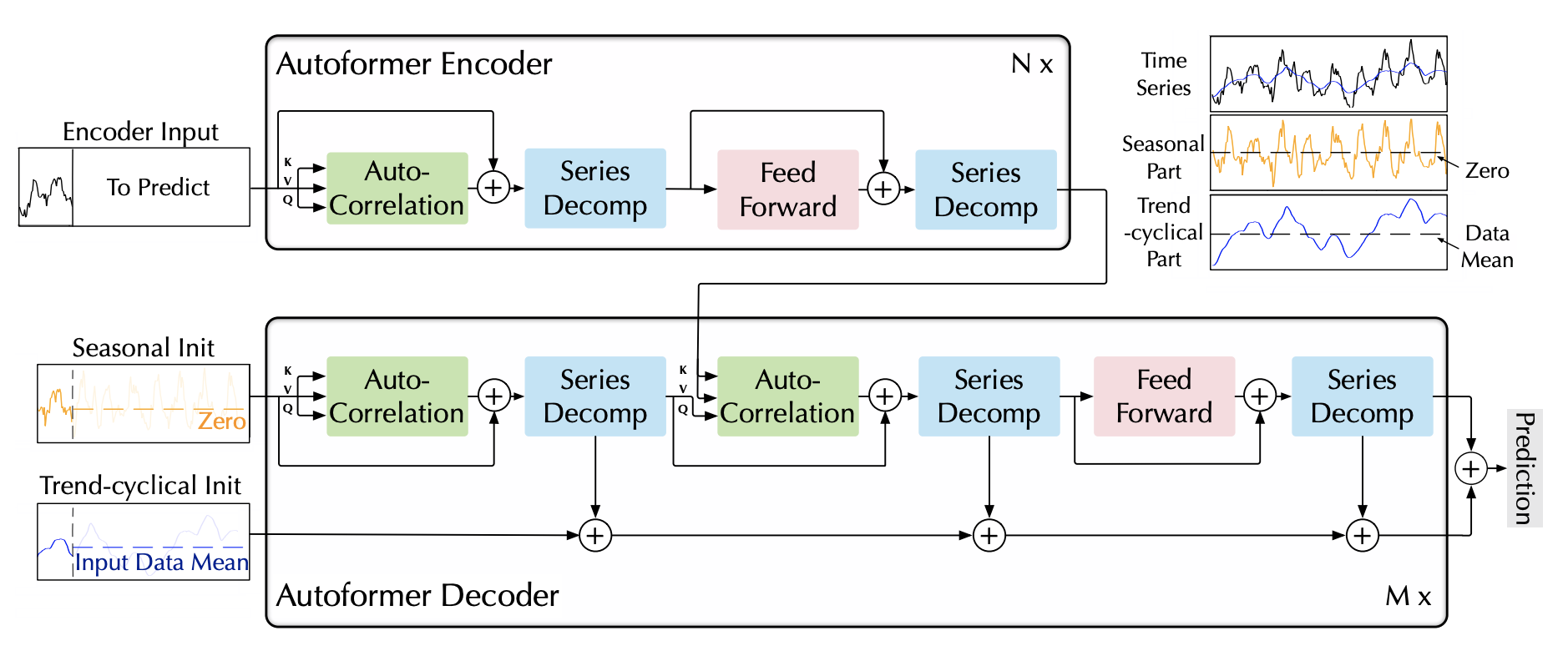 *Figure 1. Autoformer
Architecture.*
## 1. Autoformer
### `Autoformer`
```python theme={null}
Autoformer(
h,
input_size,
stat_exog_list=None,
hist_exog_list=None,
futr_exog_list=None,
cat_exog_list=None,
categorical_cardinalities=None,
cat_emb_dim="fastai",
exclude_insample_y=False,
decoder_input_size_multiplier=0.5,
hidden_size=128,
dropout=0.05,
factor=3,
n_head=4,
conv_hidden_size=32,
activation="gelu",
encoder_layers=2,
decoder_layers=1,
MovingAvg_window=25,
loss=MAE(),
valid_loss=None,
max_steps=5000,
learning_rate=0.0001,
num_lr_decays=-1,
early_stop_patience_steps=-1,
val_monitor="ptl/val_loss",
val_check_steps=100,
batch_size=32,
valid_batch_size=None,
windows_batch_size=1024,
inference_windows_batch_size=1024,
start_padding_enabled=False,
training_data_availability_threshold=0.0,
step_size=1,
scaler_type="identity",
random_seed=1,
drop_last_loader=False,
alias=None,
optimizer=None,
optimizer_kwargs=None,
lr_scheduler=None,
lr_scheduler_kwargs=None,
dataloader_kwargs=None,
**trainer_kwargs
)
```
Bases:
*Figure 1. Autoformer
Architecture.*
## 1. Autoformer
### `Autoformer`
```python theme={null}
Autoformer(
h,
input_size,
stat_exog_list=None,
hist_exog_list=None,
futr_exog_list=None,
cat_exog_list=None,
categorical_cardinalities=None,
cat_emb_dim="fastai",
exclude_insample_y=False,
decoder_input_size_multiplier=0.5,
hidden_size=128,
dropout=0.05,
factor=3,
n_head=4,
conv_hidden_size=32,
activation="gelu",
encoder_layers=2,
decoder_layers=1,
MovingAvg_window=25,
loss=MAE(),
valid_loss=None,
max_steps=5000,
learning_rate=0.0001,
num_lr_decays=-1,
early_stop_patience_steps=-1,
val_monitor="ptl/val_loss",
val_check_steps=100,
batch_size=32,
valid_batch_size=None,
windows_batch_size=1024,
inference_windows_batch_size=1024,
start_padding_enabled=False,
training_data_availability_threshold=0.0,
step_size=1,
scaler_type="identity",
random_seed=1,
drop_last_loader=False,
alias=None,
optimizer=None,
optimizer_kwargs=None,
lr_scheduler=None,
lr_scheduler_kwargs=None,
dataloader_kwargs=None,
**trainer_kwargs
)
```
Bases: [BaseModel](#neuralforecast.common._base_model.BaseModel)
Autoformer
The Autoformer model tackles the challenge of finding reliable dependencies on intricate temporal patterns of long-horizon forecasting.
The architecture has the following distinctive features:
* In-built progressive decomposition in trend and seasonal components based on a moving average filter.
* Auto-Correlation mechanism that discovers the period-based dependencies by
calculating the autocorrelation and aggregating similar sub-series based on the periodicity.
* Classic encoder-decoder proposed by Vaswani et al. (2017) with a multi-head attention mechanism.
The Autoformer model utilizes a three-component approach to define its embedding:
* It employs encoded autoregressive features obtained from a convolution network.
* Absolute positional embeddings obtained from calendar features are utilized.
**Parameters:**
| Name | Type | Description | Default |
| - | - | - | - |
| `h` | [int](#int) | forecast horizon. | *required* |
| `input_size` | [int](#int) | maximum sequence length for truncated train backpropagation. Default -1 uses all history. | *required* |
| `futr_exog_list` | str list | future exogenous columns. | None |
| `hist_exog_list` | str list | historic exogenous columns. | None |
| `stat_exog_list` | str list | static exogenous columns. | None |
| `cat_exog_list` | str list | exogenous columns (from `hist_exog_list` / `futr_exog_list`) to embed instead of scale. | None |
| `categorical_cardinalities` | [dict](#dict) | mapping from each categorical column to its number of distinct categories. | None |
| `cat_emb_dim` | [str](#str) or [int](#int) | categorical embedding size strategy ('fastai', 'sqrt', 'half') or an explicit integer. | 'fastai' |
| `exclude_insample_y` | [bool](#bool) | the model skips the autoregressive features y\[t-input\_size:t] if True. | False |
| `decoder_input_size_multiplier` | [float](#float) | . | 0.5 |
| `hidden_size` | [int](#int) | units of embeddings and encoders. | 128 |
| `n_head` | [int](#int) | controls number of multi-head's attention. | 4 |
| `dropout` | [float](#float) | dropout throughout Autoformer architecture. | 0.05 |
| `factor` | [int](#int) | Probsparse attention factor. | 3 |
| `conv_hidden_size` | [int](#int) | channels of the convolutional encoder. | 32 |
| `activation` | [str](#str) | activation from \['ReLU', 'Softplus', 'Tanh', 'SELU', 'LeakyReLU', 'PReLU', 'Sigmoid', 'GELU']. | 'gelu' |
| `encoder_layers` | [int](#int) | number of layers for the TCN encoder. | 2 |
| `decoder_layers` | [int](#int) | number of layers for the MLP decoder. | 1 |
| `MovingAvg_window` | [int](#int) | window size for the moving average filter. | 25 |
| `loss` | PyTorch module | instantiated train loss class from [losses collection](./losses.pytorch.html). | [MAE](#neuralforecast.losses.pytorch.MAE)() |
| `valid_loss` | PyTorch module | instantiated validation loss class from [losses collection](./losses.pytorch.html). | None |
| `max_steps` | [int](#int) | maximum number of training steps. | 5000 |
| `learning_rate` | [float](#float) | Learning rate between (0, 1). | 0.0001 |
| `num_lr_decays` | [int](#int) | Number of learning rate decays, evenly distributed across max\_steps. | -1 |
| `early_stop_patience_steps` | [int](#int) | Number of validation iterations before early stopping. | -1 |
| `val_monitor` | [str](#str) | metric to monitor for early stopping. Valid options: "ptl/val\_loss", "valid\_loss", "train\_loss". Default: "ptl/val\_loss". | 'ptl/val\_loss' |
| `val_check_steps` | [int](#int) | Number of training steps between every validation loss check. | 100 |
| `batch_size` | [int](#int) | number of different series in each batch. | 32 |
| `valid_batch_size` | [int](#int) | number of different series in each validation and test batch, if None uses batch\_size. | None |
| `windows_batch_size` | [int](#int) | number of windows to sample in each training batch, default uses all. | 1024 |
| `inference_windows_batch_size` | [int](#int) | number of windows to sample in each inference batch. | 1024 |
| `start_padding_enabled` | [bool](#bool) | if True, the model will pad the time series with zeros at the beginning, by input size. | False |
| `training_data_availability_threshold` | [Union](#Union)\[[float](#float), [List](#List)\[[float](#float)]] | minimum fraction of valid data points required for training windows. Single float applies to both insample and outsample; list of two floats specifies \[insample\_fraction, outsample\_fraction]. Default 0.0 allows windows with only 1 valid data point (current behavior). | 0.0 |
| `step_size` | [int](#int) | step size between each window of temporal data. | 1 |
| `scaler_type` | [str](#str) | type of scaler for temporal inputs normalization see [temporal scalers](https://github.com/Nixtla/neuralforecast/blob/main/neuralforecast/common/_scalers.py). | 'identity' |
| `random_seed` | [int](#int) | random\_seed for pytorch initializer and numpy generators. | 1 |
| `drop_last_loader` | [bool](#bool) | if True `TimeSeriesDataLoader` drops last non-full batch. | False |
| `alias` | [str](#str) | optional, Custom name of the model. | None |
| `optimizer` | Subclass of 'torch.optim.Optimizer' | optional, user specified optimizer instead of the default choice (Adam). | None |
| `optimizer_kwargs` | [dict](#dict) | optional, list of parameters used by the user specified `optimizer`. | None |
| `lr_scheduler` | Subclass of 'torch.optim.lr\_scheduler.LRScheduler' | optional, user specified lr\_scheduler instead of the default choice (StepLR). | None |
| `lr_scheduler_kwargs` | [dict](#dict) | optional, list of parameters used by the user specified `lr_scheduler`. | None |
| `dataloader_kwargs` | [dict](#dict) | optional, list of parameters passed into the PyTorch Lightning dataloader by the `TimeSeriesDataLoader`. | None |
| `**trainer_kwargs` | [int](#int) | keyword trainer arguments inherited from [PyTorch Lightning's trainer](https://pytorch-lightning.readthedocs.io/en/stable/api/pytorch_lightning.trainer.trainer.Trainer.html?highlight=trainer). | {} |
References
* [Wu, Haixu, Jiehui Xu, Jianmin Wang, and Mingsheng Long. "Autoformer: Decomposition transformers with auto-correlation for long-term series forecasting"](https://proceedings.neurips.cc/paper/2021/hash/bcc0d400288793e8bdcd7c19a8ac0c2b-Abstract.html)
#### `Autoformer.fit`
```python theme={null}
fit(
dataset, val_size=0, test_size=0, random_seed=None, distributed_config=None
)
```
Fit.
The `fit` method, optimizes the neural network's weights using the
initialization parameters (`learning_rate`, `windows_batch_size`, ...)
and the `loss` function as defined during the initialization.
Within `fit` we use a PyTorch Lightning `Trainer` that
inherits the initialization's `self.trainer_kwargs`, to customize
its inputs, see [PL's trainer arguments](https://pytorch-lightning.readthedocs.io/en/stable/api/pytorch_lightning.trainer.trainer.Trainer.html?highlight=trainer).
The method is designed to be compatible with SKLearn-like classes
and in particular to be compatible with the StatsForecast library.
By default the `model` is not saving training checkpoints to protect
disk memory, to get them change `enable_checkpointing=True` in `__init__`.
**Parameters:**
| Name | Type | Description | Default |
| - | - | - | - |
| `dataset` | [TimeSeriesDataset](#TimeSeriesDataset) | NeuralForecast's `TimeSeriesDataset`, see [documentation](./tsdataset.html). | *required* |
| `val_size` | [int](#int) | Validation size for temporal cross-validation. | 0 |
| `random_seed` | [int](#int) | Random seed for pytorch initializer and numpy generators, overwrites model.**init**'s. | None |
| `test_size` | [int](#int) | Test size for temporal cross-validation. | 0 |
**Returns:**
| Type | Description |
| - | - |
| None | |
#### `Autoformer.predict`
```python theme={null}
predict(
dataset,
test_size=None,
step_size=1,
random_seed=None,
quantiles=None,
h=None,
explainer_config=None,
**data_module_kwargs
)
```
Predict.
Neural network prediction with PL's `Trainer` execution of `predict_step`.
**Parameters:**
| Name | Type | Description | Default |
| - | - | - | - |
| `dataset` | [TimeSeriesDataset](#TimeSeriesDataset) | NeuralForecast's `TimeSeriesDataset`, see [documentation](./tsdataset.html). | *required* |
| `test_size` | [int](#int) | Test size for temporal cross-validation. | None |
| `step_size` | [int](#int) | Step size between each window. | 1 |
| `random_seed` | [int](#int) | Random seed for pytorch initializer and numpy generators, overwrites model.**init**'s. | None |
| `quantiles` | [list](#list) | Target quantiles to predict. | None |
| `h` | [int](#int) | Prediction horizon, if None, uses the model's fitted horizon. Defaults to None. | None |
| `explainer_config` | [dict](#dict) | configuration for explanations. | None |
| `**data_module_kwargs` | [dict](#dict) | PL's TimeSeriesDataModule args, see [documentation](https://pytorch-lightning.readthedocs.io/en/1.6.1/extensions/datamodules.html#using-a-datamodule). | {} |
**Returns:**
| Type | Description |
| - | - |
| None | |
### Usage Example
```python theme={null}
import pandas as pd
import matplotlib.pyplot as plt
from neuralforecast import NeuralForecast
from neuralforecast.models import Autoformer
from neuralforecast.utils import AirPassengersPanel, AirPassengersStatic, augment_calendar_df
AirPassengersPanel, calendar_cols = augment_calendar_df(df=AirPassengersPanel, freq='M')
Y_train_df = AirPassengersPanel[AirPassengersPanel.ds=AirPassengersPanel['ds'].values[-12]].reset_index(drop=True) # 12 test
model = Autoformer(h=12,
input_size=24,
hidden_size = 16,
conv_hidden_size = 32,
n_head=2,
loss=MAE(),
futr_exog_list=calendar_cols,
scaler_type='robust',
learning_rate=1e-3,
max_steps=300,
val_check_steps=50,
early_stop_patience_steps=2)
nf = NeuralForecast(
models=[model],
freq='ME'
)
nf.fit(df=Y_train_df, static_df=AirPassengersStatic, val_size=12)
forecasts = nf.predict(futr_df=Y_test_df)
Y_hat_df = forecasts.reset_index(drop=False).drop(columns=['unique_id','ds'])
plot_df = pd.concat([Y_test_df, Y_hat_df], axis=1)
plot_df = pd.concat([Y_train_df, plot_df])
if model.loss.is_distribution_output:
plot_df = plot_df[plot_df.unique_id=='Airline1'].drop('unique_id', axis=1)
plt.plot(plot_df['ds'], plot_df['y'], c='black', label='True')
plt.plot(plot_df['ds'], plot_df['Autoformer-median'], c='blue', label='median')
plt.fill_between(x=plot_df['ds'][-12:],
y1=plot_df['Autoformer-lo-90'][-12:].values,
y2=plot_df['Autoformer-hi-90'][-12:].values,
alpha=0.4, label='level 90')
plt.grid()
plt.legend()
plt.plot()
else:
plot_df = plot_df[plot_df.unique_id=='Airline1'].drop('unique_id', axis=1)
plt.plot(plot_df['ds'], plot_df['y'], c='black', label='True')
plt.plot(plot_df['ds'], plot_df['Autoformer'], c='blue', label='Forecast')
plt.legend()
plt.grid()
```
## 2. Auxiliary functions
### `Decoder`
```python theme={null}
Decoder(layers, norm_layer=None, projection=None)
```
Bases: [Module](#torch.nn.Module)
Autoformer decoder
### `DecoderLayer`
```python theme={null}
DecoderLayer(
self_attention,
cross_attention,
hidden_size,
c_out,
conv_hidden_size=None,
MovingAvg=25,
dropout=0.1,
activation="relu",
)
```
Bases: [Module](#torch.nn.Module)
Autoformer decoder layer with the progressive decomposition architecture
### `Encoder`
```python theme={null}
Encoder(attn_layers, conv_layers=None, norm_layer=None)
```
Bases: [Module](#torch.nn.Module)
Autoformer encoder
### `EncoderLayer`
```python theme={null}
EncoderLayer(
attention,
hidden_size,
conv_hidden_size=None,
MovingAvg=25,
dropout=0.1,
activation="relu",
)
```
Bases: [Module](#torch.nn.Module)
Autoformer encoder layer with the progressive decomposition architecture
### `LayerNorm`
```python theme={null}
LayerNorm(channels)
```
Bases: [Module](#torch.nn.Module)
Special designed layernorm for the seasonal part
### `AutoCorrelationLayer`
```python theme={null}
AutoCorrelationLayer(
correlation, hidden_size, n_head, d_keys=None, d_values=None
)
```
Bases: [Module](#torch.nn.Module)
Auto Correlation Layer
### `AutoCorrelation`
```python theme={null}
AutoCorrelation(
mask_flag=True,
factor=1,
scale=None,
attention_dropout=0.1,
output_attention=False,
)
```
Bases: [Module](#torch.nn.Module)
AutoCorrelation Mechanism with the following two phases:
(1) period-based dependencies discovery
(2) time delay aggregation
This block can replace the self-attention family mechanism seamlessly.
## Related topics
- [Long Horizon](/datasetsforecast/long_horizon.html.md)
- [Long-Horizon Original Datasets](/datasetsforecast/long_horizon2.html.md)
- [Long-Horizon Forecasting with NHITS](/neuralforecast/docs/tutorials/longhorizon_nhits.html.md)
- [Automatic Forecasting](/neuralforecast/models.html.md)
- [Long-Horizon Forecasting with Transformer models](/neuralforecast/docs/tutorials/longhorizon_transformers.html.md)